
SAFETY TRAINING TALK
heat and cold stress
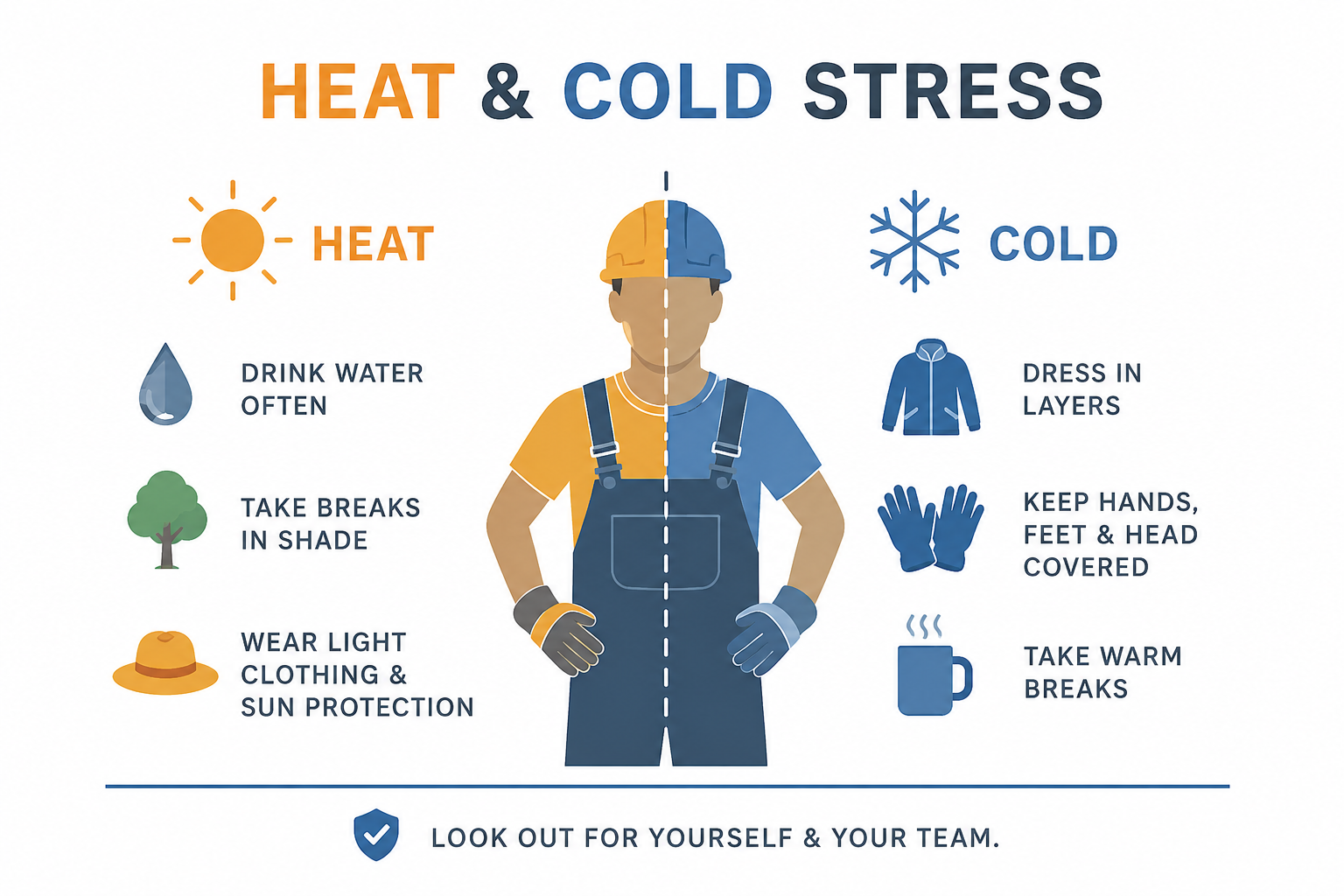
To be able to identify symptoms of heat stroke, exhaustion, and to learn the possible outcomes of overexposure to the sun. As well as, to recognize the symptoms and results of overexposure to the cold. In regards to all these outcomes preventative methods and emergency reactions will be learned.
HEAT STRESS
Heat Stress is a build up of body heat generated either internally by muscle use or externally by the environment. Heat stroke and heat exhaustion result when the body is overwhelmed by heat. As the heat increases, core body temperature rises and the heart rate increases. Factors such as: air temperature, relative humidity, types of clothing, age, gender, medications, hydration levels can all affect the body’s temperature.
COLD EXPOSURE
Cold exposure can lead to serious illness even if not exposed to weather that is freezing. Wind, humidity and moisture remove body heat, which can eventually lead to hypothermia. The cold primarily affects the body’s extremities. Hand and feet are further away from the body core and have less blood flow.
HEAT STRESS
Prevention:
• Heat illness is preventable.
• Any heat stress can impair functioning.
• People work slower and less efficiently when they are suffering from heat stress.
• Employers, Supervisors, and Workers all play an essential role in prevention by using their good judgement to assess work situations and determine what is needed to prevent workers from being affected by the heat.
CONTROL
• Drink one glass of cool water every 15-30 minutes worked, depending on the heat and humidity.
• Avoid caffeinated drinks, alcohol and drugs as they may make the body lose water and increase the risk of health effects on the body.
• Build up tolerance. Heat tolerance is normally built up over a one to two week time period.
• Take breaks in a cooler area to cool down the body.
• Adapt work and pace to the weather.
• Manage work activities and match them to employees’ physical condition.
• Use protective gear, such as cooling garments and cooling vests to reduce heat stress on the body.
• Know how to recognize heat stress symptoms and how to offer first aid treatment.
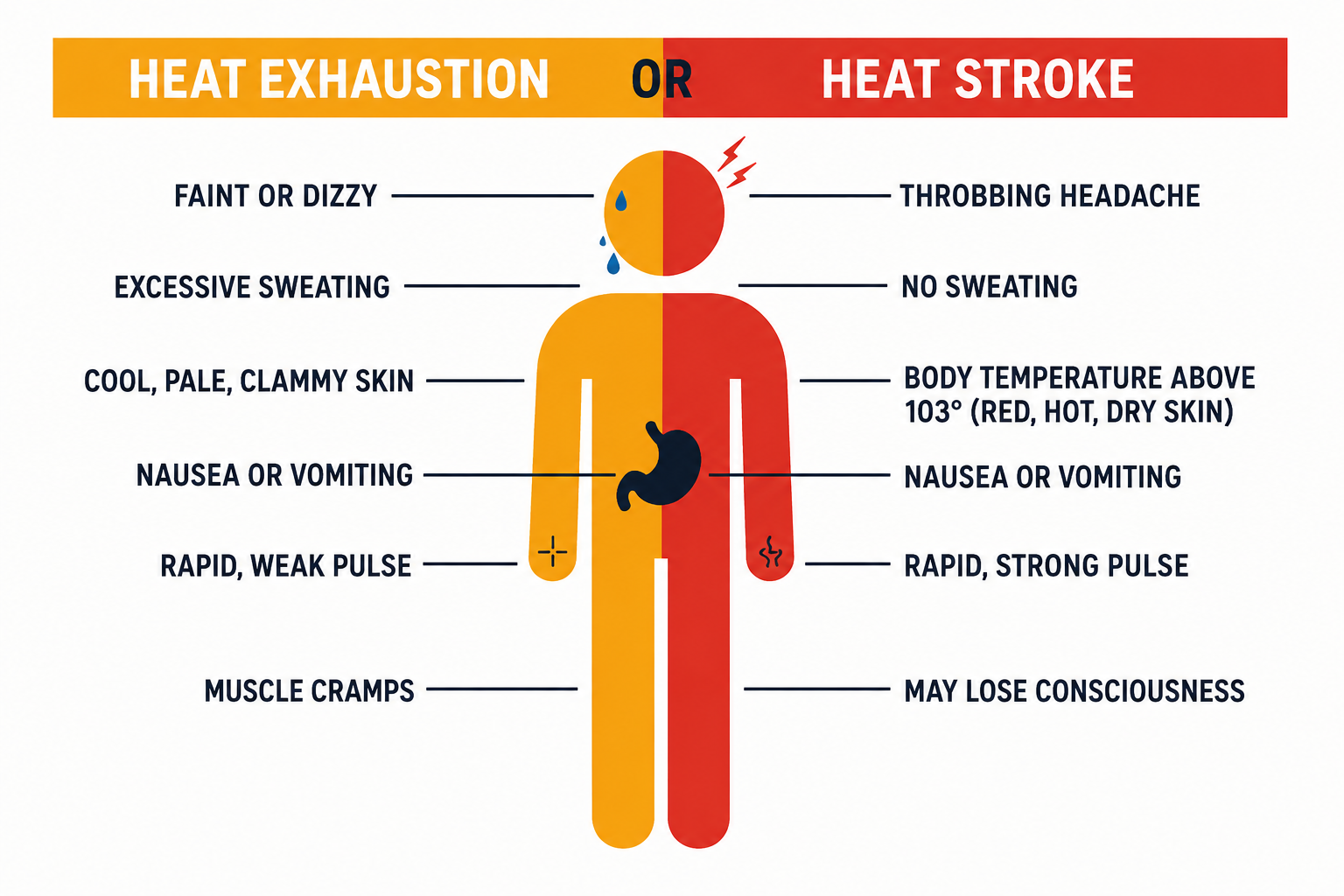
HEAT STROKE FIRST AID
• Move the victim to a cool place and remove heavy clothing; light clothing can be left in place.
• Immediately cool the victim by any available means, such as placing ice packs at areas with abundant blood supply (neck, armpit, groin). Towels that are constantly kept wet are also effective.
• To prevent hypothermia continue cooling the victim until their temperature drops to 102*F(39*C).
• Keep the victims head and shoulders slightly elevated.
• Seek medical attention immediately. All heat stroke victims need hospitalization.
• Care for seizures if they occur.
HEAT EXHAUSTION FIRST AID
• Move the victim to a cool place.
• Keep the victim lying down with legs straight and elevated 8-12 inches (20-30cm).
• Cool the victim by applying cold packs or wet towels. Fan the victim.
• Give the victim cold water if he or she is fully conscious.
• If no improvement is noted within 30 minutes, seek medical attention.
SUN EXPOSURE
Skin Cancer Types:
• Basal cell – shiny appearance. Can be removed by topical treatments. Can be cured if caught early.
• Squamous cell – rusty, warty appearance. Can be removed by topical treatments. Can be cured if caught early.
• Melanoma – dark mole-like appearance. However malignant melanoma carries more significant, even fatal implications. Melanoma’s incidence has been steadily rising, affecting people of all ages.
Minimizing Risks:
• Avoid sun exposure between 10:00 am and 3:00 pm, whenever possible.
• Protective clothing such as long sleeves, long pants, high socks, and gloves act as a barrier between the skin and sun.
• Wear a wide brimmed hat, cap flap or the flap on cap.
• Use a sunscreen with sun protection factor (SPF) of 30 or more while working outdoors. Reapply sunscreen ever two hours.
COLD WEATHER INJURIES
• Frostnip – is the freezing of the top layers of skin tissue and is normally reversable. It mostly affects cheeks, earlobes, fingers, and toes. Symptoms include: Numbness, top layer of skin feeling hard/tough while deeper tissue is soft, skin becomes white and waxy. Treatment: Rewarm the area gently by blowing warm air on it or placing it against a warm part of your body.
• Frostbite – is the actual freezing of the tissue and/or body part. Ice crystals form inside the skin that can destroy the tissue, and you could lose skin or part of a body part. It affects the ear, nose, fingers and toes most often. Superficial frostbite includes all layers of skin, and deep frostbite can include freezing of muscle and/or bone. Symptoms include: Skin that is white and has a “wooden” feel all the way trough, and numbness. Affected person with Frostbite may also begin showing different coloured skin complexions, it may be more difficult to detect for various skin types. Examples include: skin turning red, white and grey or black. Treatment: Move the person to a warm area, put the affected area in warm water (40.5*C-43*C) until the skin becomes flushed (no hotter or additional damage will result), wrap the area in a sterile gauze while keeping affected areas from touching each other. If you can’t keep the affected area warm, do not rewarm until able to. If normal sensation hasn’t returned in 30 minutes then seek medical attention.
• Hypothermia – is general cooling of the body. When the body drops below the normal temperature of 37*C, serious problems can arise. Severe hypothermia can lead to death. Symptoms of mild hypothermia include: Uncontrollable shivering, still able to walk and talk, numbness of hands, unable to complete tasks with hands. Treatment for mild hypothermia: encourage physical activity, drink hot caffeine-free and alcohol-free drinks, warm the person and take off all wet cloths, gradually warm them by applying hot packs or water bottles to the groin, head, neck and sides of the chest. Immersing a person in warm water rewarms them too fast.
SEVERE HYPOTHERMIA
Symptoms of severe hypothermia include: Shivering stops, poor muscle coordination and unable to walk, pulse and respiration rates decrease, irrational/incoherent behavior. Treatment for severe hypothermia: Immediately seek medical attention.
Call 9-1-1 and let the hospital rewarm the person, If medical attention is not possible then wrap the person warmly and transport to safety gently (jostling could cause cardiac arrest), remove all wet clothing and put them in a warm blanket, apply gentle heat sources (heat packs, another body) to armpits, side, chest and groin. Warm the person lungs with mouth-to-mouth breathing. Do not rub extremities or drink hot drinks as this draws blood away from vital organs.
WRAP UP: THINGS TO CONSIDER
POINTS TO CONSIDER
• Heat stress is serious and can affect all ages.
• Have plenty of liquids available and administer first aid as needed.
• Never ignore symptoms of heat, sun, and cold related disorders.
• A major cause of skin cancer is sun exposure. Apply sunscreen 30+SPF every two hours.
• Wear loose, dry, and warm clothing in freezing temperatures.
• Frostnip is the top skin tissue layers freezing. Frostbite is the freezing of all layers of skin, muscle and/or bones. Hypothermia is the general cooling of the entire body.
ALWAYS REMEMBER THAT…
• Employers are responsible for safety procedures and safety.
• Employees are responsible to carry out work in a safe manner while keeping an eye out for eachother.
I read it. I get it.
Safety begins with you. By submitting your name you confirm that you have read, understood and will abide by this safety talk to make your workplace the safest it can be.
If at any point you fill unsafe or something requires immediate attention please call or text Josh at 613-875-3986.